
What is electrochemotherapy?
Electrochemotherapy is a safe, minimally invasive treatment for skin tumors.
It combines the action of an anticancer drug with a technique that greatly increases its efficacy inside the tumor. The aim is to destroy tumor cells while leaving the surrounding healthy tissue intact, which means better cosmetic results and preserved function of the treated organ.
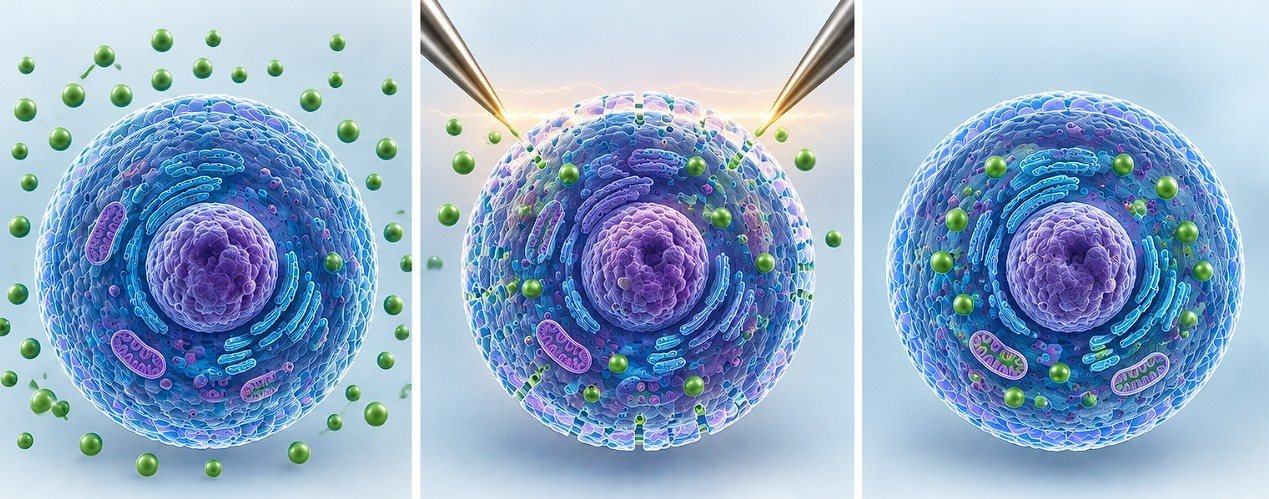
- The drug surrounds the cell but cannot cross its membrane.
- Electric pulses open transient pores.
- The drug enters and stays inside the cell.
How does it work?
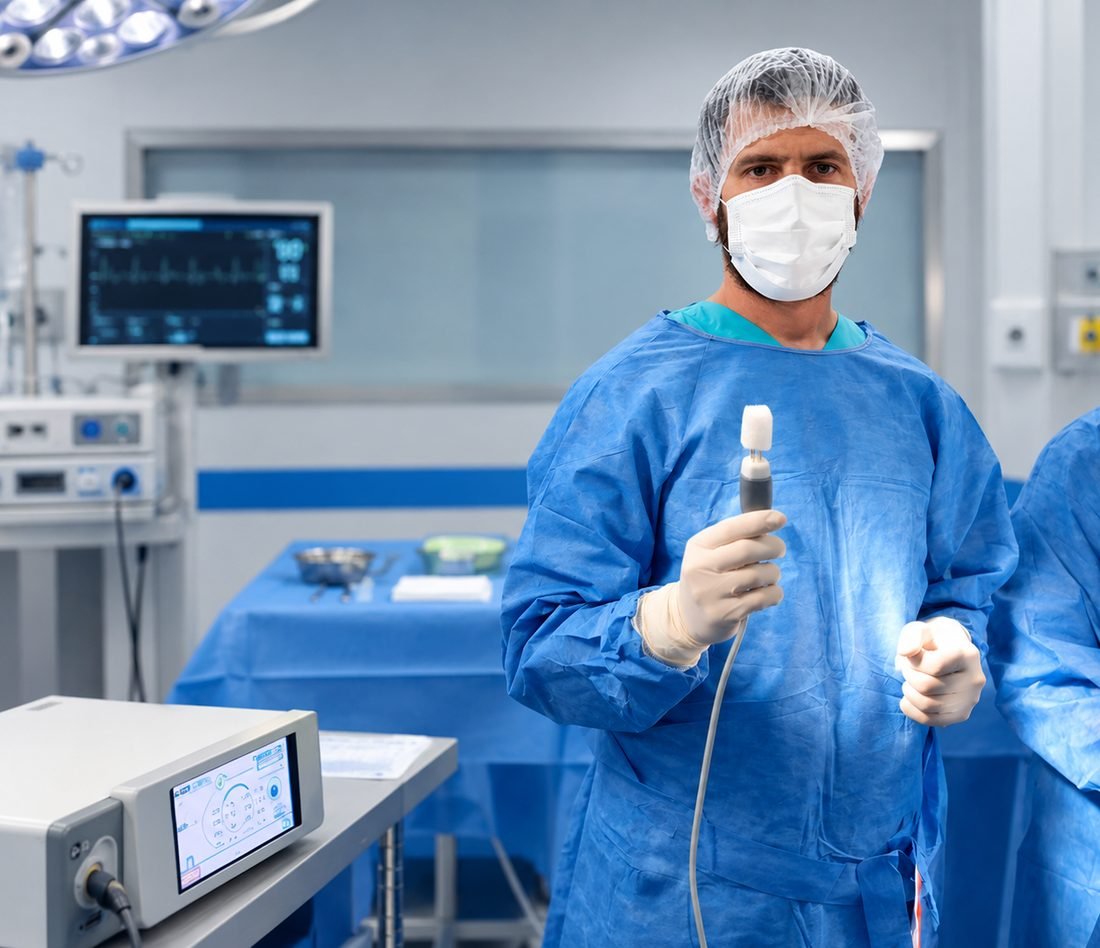
Electrochemotherapy consists of giving an anticancer drug and applying electric pulses to the tumor with equipment specifically designed for electroporation in oncology and approved by ANMAT, Argentina's medical device regulator.
Electroporation pulses transiently permeabilize cell membranes, so the drug enters the tumor with more than 1,000 times greater efficacy while the surrounding healthy tissue stays protected.
Because the drug acts mainly within the tumor, the typical side effects of chemotherapy, such as malaise, nausea or hair loss, usually do not occur.
The procedure takes about one hour. Afterwards the patient goes home to recover and can resume usual activities within the first few days.
Benefits of electrochemotherapy
The technique offers significant benefits, especially for complex lesions or those located in sensitive areas.
High local efficacy
Raises drug concentration in the tumor and improves response without increasing systemic side effects.

Preserves healthy tissue
Acts only on dividing cells, preserving structure and function with excellent cosmetic results.

Outpatient procedure
Treatment takes less than an hour and patients go home the same day, with a comfortable and quick recovery.

Results within weeks
The lesion shrinks progressively and the response starts to become evident about thirty days after treatment.

Compatible with other therapies
Highly recommended to shrink a lesion before surgery, when other therapies have failed, or to enhance other treatments.

Suitable for complex cases
Electrochemotherapy can achieve good results where other therapies would leave functional impairment.

Excellent cosmetic results
Allows proper healing while sparing healthy skin, with superior cosmetic outcomes in sensitive areas.

Preserves function and quality of life
Reduces pain, bleeding and discomfort caused by the lesion, for a more comfortable recovery and fewer daily limitations.

History of electrochemotherapy
Dr. Lluis Mir, a researcher at CNRS (France), develops the technique and achieves a marked increase in the efficacy of anticancer drugs.
After the ESOPE project guidelines are published, electrochemotherapy becomes a standardized treatment in Europe and spreads quickly across the region.
The founders of GEM begin electrochemotherapy research in Argentina.
Argentina approves its first medical-grade electroporator, marking the formal start of electrochemotherapy in human medicine in Latin America. GEM is established to make the therapy available to patients.
Evidence
Electrochemotherapy follows international protocols and is endorsed by guidelines such as ESOPE, NICE and the European dermato-oncology guidelines (EDF/EADO/EORTC). Our team has been researching the technique since 2009.
International guidelines
Recommendations we follow in every treatment.
- ESOPE 2018: Updated standard operating procedures for electrochemotherapy of cutaneous tumours and skin metastasesGehl J, Sersa G, Matthiessen LW, et al. Acta Oncologica, 57(7):874-882, 2018.Download
- NICE IPG478: Electrochemotherapy for primary basal cell carcinoma and primary squamous cell carcinomaNational Institute for Health and Care Excellence, United Kingdom, 2014.Download
- NICE IPG446: Electrochemotherapy for metastases in the skin from tumours of non-skin origin and melanomaNational Institute for Health and Care Excellence, United Kingdom, 2013.Download
- European consensus-based interdisciplinary guideline for diagnosis and treatment of basal cell carcinoma: update 2023 (EDF/EADO/EORTC)Peris K, Fargnoli MC, Kaufmann R, et al. European Journal of Cancer, 192:113254, 2023.Download
- European consensus-based interdisciplinary guideline for melanoma. Part 2: Treatment, update 2024 (EDF/EADO/EORTC)Garbe C, Amaral T, Peris K, et al. European Journal of Cancer, 215:115153, 2025.Download
- Diagnosis and treatment of Kaposi's sarcoma: European consensus-based interdisciplinary guideline (EDF/EADO/EORTC)Lebbe C, Garbe C, Stratigos AJ, et al. European Journal of Cancer, 114:117-127, 2019.Download
International studies
European expert consensus and results from the InspECT registry, with thousands of treated lesions.
- European e-Delphi process to define expert consensus on electrochemotherapy treatment indications, procedural aspects, and quality indicators in melanomaCampana LG, et al. British Journal of Surgery, 110(7), 2023.Download
- Electrochemotherapy in the treatment of cutaneous malignancy: outcomes and subgroup analysis from the InspECT database for 2482 lesions in 987 patients (2008-2019)Clover AJP, de Terlizzi F, Bertino G, et al. European Journal of Cancer, 138:30-40, 2020.Download
- Efficacy of electrochemotherapy in breast cancer patients of different receptor status: the INSPECT experienceDi Prata C, Mascherini M, MacKenzie Ross A, et al. Cancers, 15(12):3116, 2023.Download
- Treatment of basal cell carcinoma with electrochemotherapy: insights from the InspECT registry (2008-2019)Bertino G, Muir T, Odili J, et al. Current Oncology, 29(8):5324-5337, 2022.Download
- Combination of pembrolizumab with electrochemotherapy in cutaneous metastases from melanoma: a comparative retrospective study from the InspECT and Slovenian Cancer RegistryCampana LG, Peric B, Mascherini M, et al. Cancers, 13(17):4289, 2021.Download
Publications by the GEM team
Clinical and technical experience of our group.
- Electroquimioterapia, a propósito de 3 casosMiranda J, Michinski S, Lertora R, Tellado M, Cespedes N, Cinat G, Maglietti F. Prensa Médica Argentina, 112(1):85-94, 2026.Download
- Electroquimioterapia para el tratamiento de un carcinoma perianal concomitante a un carcinoma de cuello uterinoCuéllar S, Lay L, Silva M, Martínez N, Michinski S, Ostojich N, Maglietti F. Medicina (Buenos Aires), 86:1067-1071, 2026.Download
- Non-melanoma skin cancer treated with electrochemotherapy: clinical outcomes and tolerabilityMaglietti FH, Lertora R, Martinez NS, Da Rosa Silva A, Damasceno Silva MR, Michinski SD. Cancer Research, 86(7 Suppl):305, 2026.Download
- Electrode corrosion in electrochemotherapy can hinder treatment efficacyCampastri A, Cilio A, Ribeiro M, Martinez N, Michinski S, Maglietti F. Bioelectricity, 2025.Download
- Electrode tip wear increases needle deflection and procedural complexity in electrochemotherapyCilio A, Campastri A, Ribeiro M, Martinez N, Michinski S, Maglietti F. Bioelectricity, 2025.Download
- Electrochemotherapy for the treatment of head and neck squamous cell carcinomaMaglietti FH, Michinski SD, Evans LA, Lertora R. Cancer Research, 85(8 Suppl 1):4707, 2025.Download
Questions about the technique
What scientific evidence supports this treatment?
Electrochemotherapy follows internationally standardized protocols and has almost two decades of clinical use in Europe. The ESOPE 2018 guidelines are the global reference for treating cutaneous tumors.
Which tumors is electrochemotherapy useful for?
It is especially effective for cutaneous and subcutaneous tumors, including lesions on the head and neck, scalp, eyelids, nasal ala, ears, mouth, neck, limbs, hands, soles of the feet and anogenital region.
It can be used for basal cell carcinoma, squamous cell carcinoma, melanoma and keloids. For other conditions, the indication is assessed case by case.
Does it work for internal tumors such as pancreas or lung?
Electrochemotherapy is currently indicated mainly for cutaneous or subcutaneous lesions. Its use in internal organ tumors is still under research and is not part of standard clinical practice.
Can I combine this treatment with others?
Yes. Electrochemotherapy can be used together with surgery, radiotherapy, immunotherapy, chemotherapy or other systemic treatments. Your physician will define the best strategy for your case.
Do you have a question?
We are available to assess your case, train you or advise your institution.